Best Electric Bikes for Delivery Riders UK: What Actually Survives the Job

Updated August 2026 · Voltryv Editorial Team
Delivery riding is the hardest life an e-bike can have. A courier covers in a fortnight what a commuter covers in a year, almost all of it stop-start, fully loaded, in whatever the weather is doing, with the bike left locked outside at every drop.
Bikes chosen for a 6 km commute do not survive it. This guide is about what does — written for riders on Deliveroo, Uber Eats, Just Eat and the courier apps, where the bike is not a lifestyle purchase but a tool that has to pay for itself.
Start with the battery maths, not the bike
Everything else is secondary. A delivery shift is not a commute — you are moving almost continuously for hours, with heavy assist use from a standing start at every junction and every drop.
Realistic consumption for delivery work is 12–16 Wh per kilometre, higher than the 8–12 a commuter sees, because you rarely reach an efficient cruise. Our range guide explains the maths; here is what it means for a shift:
| Battery | Realistic delivery range | Suits |
|---|---|---|
| 624 Wh | 40–50 km | A short evening shift |
| 1,123 Wh (dual) | 70–90 km | A full day, most cities |
| 1,200 Wh (single) | 75–100 km | A full day, one pack to manage |
| 1,500 Wh (dual) | 95–125 km | Long doubles, or two days between charges |
Buy more battery than your shift needs. Running a pack to empty every day is the fastest way to kill it, and a bike that dies three drops before the end of a peak period costs you the best-paying hour of the day.
What actually fails first
In order, from experience of how these bikes wear:
- Brake pads. Stop-start city work eats them. Expect to replace pads every few months rather than annually — check monthly using our maintenance guide. Hydraulic brakes are not a luxury here; cable brakes fade and stretch under this duty cycle.
- Chain and cassette. High torque plus road salt plus rain. A £6 bottle of wet lube and a weekly wipe genuinely doubles their life.
- Tyres. Glass, kerbs, potholes. Wider tyres puncture less and ride kerbs better — a real productivity difference when you are hopping up pavements at a drop (dismounted, of course; see where you may legally ride).
- The battery. Not from age but from cycles — 800–1,000 of them. A commuter takes six years to get there; a courier charging daily gets there in under three. Charging to 80% rather than 100% on ordinary days materially extends that, per our battery care guide.
- Spokes and wheels. Kerb impacts under load. Smaller wheels are structurally stronger, which is a genuine argument for a 20" bike over a 26" one in this job.
The specification that matters
- 1,100 Wh or more — anything less and you are charging mid-shift.
- Hydraulic disc brakes — non-negotiable at this mileage.
- Fat tyres (20" × 4.0") — fewer punctures, better on kerbs and wet drain covers, and stronger wheels.
- A rear rack — a loaded backpack all shift wrecks your back. Put the weight on the bike.
- A 120 kg load rating — that figure includes rider, bag and cargo, and a full thermal bag is heavier than people expect.
- Dual battery, if you can — swap mid-shift rather than stopping, and each pack ages at half the rate.
Our picks
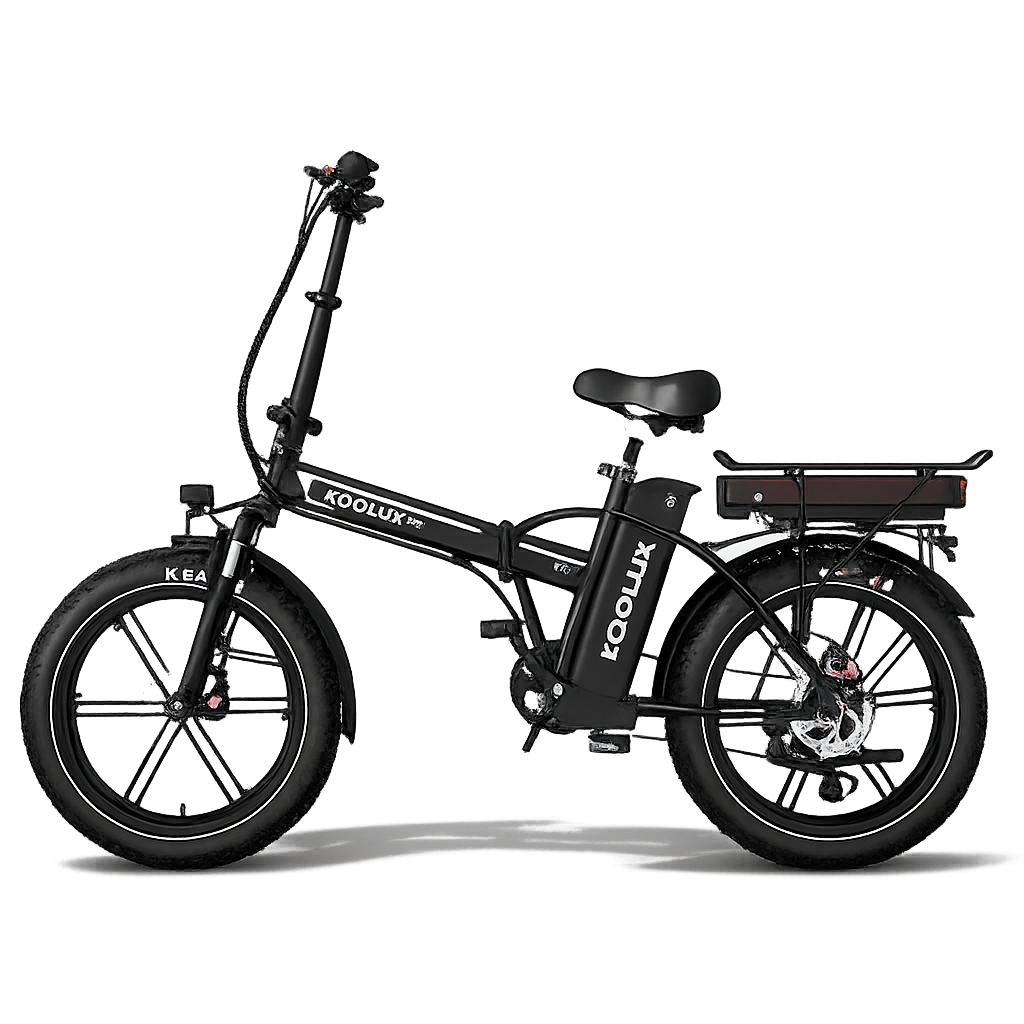
KOOLUX X9 Pro — £899 (the one we'd pick)
Dual batteries totalling 1,500 Wh, 750W platform, hydraulic brakes, 20" × 4.0" Kenda tyres, long bench saddle and a rear rack. Realistically 95–125 km of delivery riding, which covers the longest shift most riders will take, and the dual-pack arrangement halves the cycles each battery accumulates. The best-value courier bike we sell.
KOOLUX X7 — £979 (simplest to live with)
One enormous 1,200 Wh pack instead of two — nothing to swap, nothing to leave on charge at home by mistake, and the fastest charge in the range at 5–6 hours, so it recovers overnight comfortably. The step-through frame is genuinely faster to get on and off, which adds up over forty drops, and it carries both front and rear racks as standard.
KOOLUX X11 — £899 (if storage is the problem)
1,123 Wh across two packs and it folds — the answer if you live in a flat with no secure storage and the bike has to come inside every night. Same fat tyres and hydraulic brakes.
KOOLUX BK6S 750W — £739 (entry point)
624 Wh is short for a full day, so treat this as the option for shorter evening shifts or a second bike. Strong platform and folds for storage.
Does it pay for itself?
This is the part that decides it. Running costs are covered fully in our running costs guide, but for a courier specifically:
- Electricity: a 1,500 Wh pack costs about 44p to fill. Across a 100 km shift that is well under half a penny per kilometre.
- Consumables: budget £150–£250 a year at delivery mileage — more pads and chains than a commuter, but still small.
- Against a moped: no fuel, no road tax, no MOT, no insurance requirement, no CBT, and access to cycle lanes that jump traffic queues.
- Payback: at typical UK courier earnings an £899 bike is generally covered within a few weeks of full-time riding.
Two things couriers get wrong
Skimping on the lock. Your bike is unattended dozens of times a day in the busiest parts of town. A Sold Secure Gold lock and taking the battery into the building at longer drops is the minimum — see our security guide. Losing the bike stops your income entirely.
Assuming a throttle makes it faster. Every road-legal e-bike assists to the same 15.5 mph. In city traffic your average is set by junctions and lights, not top speed — which is exactly why an e-bike competes with a moped on delivery times. Our speed guide has the numbers.
Common questions
Do I need insurance to deliver by e-bike?
Not by law — an EAPC needs none. But if the bike is how you earn, theft cover is worth more here than to any commuter, and some platforms expect third-party cover. See our insurance guide.
Can I use an unlocked higher-power mode to go faster between drops?
No. On any public road that makes the bike an unregistered motor vehicle — fines, licence points and possible seizure, which for a working rider means losing the tool and the income together.
Is a bigger battery or a second battery better?
A second pack if your shifts are unpredictable, since you can swap without stopping to charge. One big pack if you value simplicity — nothing to forget, nothing to carry.
Kit that earns
Every bike above is in UK stock with free delivery and a 2-year warranty. See the range, and if you are employed rather than self-employed, Cycle to Work takes 28–42% off.