Best Electric Bikes for Hills UK: What Actually Climbs

Updated September 2026 · Voltryv Editorial Team
Flat-ground reviews tell you almost nothing. Any e-bike feels strong on the level — the question that decides whether you enjoy owning one is what happens on the climb between the station and your front door.
If you ride in Sheffield, Bristol, Bath, Edinburgh, Lancaster, Halifax, the Chilterns or any of north London's short vicious ramps, this is the guide. It covers the gradient maths, what a manufacturer's climbing figure actually means, what a hill costs you in battery, and which bikes in our range genuinely get up.
First, the number that actually matters
Hills are quoted two ways and people mix them up constantly. Road signs and cycling apps use percentage; e-bike spec sheets use degrees. They are wildly different numbers for the same hill.
| Gradient (%) | In degrees | Old money | What it feels like |
|---|---|---|---|
| 5% | 2.9° | 1 in 20 | A long drag. Noticeable, not hard. |
| 10% | 5.7° | 1 in 10 | A proper hill. Most UK town climbs. |
| 15% | 8.5° | 1 in 6.7 | Steep. You drop to the lowest gears. |
| 20% | 11.3° | 1 in 5 | Very steep. Unassisted riders walk. |
| 25% | 14.0° | 1 in 4 | Brutal. Sheffield and Bristol's worst streets. |
| 47% | 25.0° | 1 in 2.1 | Not a road. A ski slope. |
For scale: Vale Street in Bristol, often called England's steepest residential street, is around 22%. Sheffield's notorious Blake Street is about 16%. Hardknott Pass tops out near 30%. Almost no British road you commute on exceeds 25%, and most "killer" hills people describe are 8–14%.
What "25° climbing ability" really means
Every bike in our range — and most fat-tyre e-bikes sold in the UK — is listed with a 25° climbing ability. Read that honestly. Taken literally it is a 47% gradient, which is steeper than any public road in Britain.
That figure is a manufacturer bench number: a short burst, on a test ramp, typically with a light rider and often in the unlocked mode that is not road-legal in the UK. It is useful for comparing two bikes from the same maker. It is not a promise that your 95 kg self plus a week's shopping will float up a 25% wall.
Treat a climbing figure the way you treat a quoted range: a best case. What follows is the real case.
The power a hill actually demands
Climbing is one of the few parts of cycling where the physics is simple and honest. Lifting weight against gravity costs a predictable number of watts. Here is a 120 kg system — say an 85 kg rider, a 30 kg fat-tyre e-bike and a few kilos of kit — at realistic climbing speeds:
| Gradient | Your speed | Total power needed | Motor's share* |
|---|---|---|---|
| 5% | 15 km/h | ~330 W | ~210 W |
| 10% | 12 km/h | ~450 W | ~330 W |
| 15% | 10 km/h | ~530 W | ~410 W |
| 20% | 8 km/h | ~545 W | ~425 W |
| 25% | 6 km/h | ~500 W | ~380 W |
*Assuming you contribute a steady 120 W, which is an ordinary fit-ish rider pedalling properly rather than freewheeling.
Two things fall out of that table, and they are the whole story of e-bike climbing.
One: the demand stops rising past about 15%. Not because steep hills get easier, but because you slow down, and power is force times speed. Above 15% the limit is no longer watts — it is whether the motor can produce enough torque at crawling speed without cooking itself.
Two: a hill needs more than 250 W, and that is fine. The UK's EAPC rules cap continuous rated power at 250 W and assistance at 15.5 mph — they do not cap what a motor may draw in short bursts. A road-legal e-bike pulling 400 W up a two-minute climb is behaving exactly as designed. Our speed and power guide explains where the legal lines actually sit.
Five things that decide whether a bike climbs
- Controller amps, not just motor watts. A 750W platform running a higher-current controller delivers more torque at low rpm than a 350W one, which is why our 750W bikes pull away from the smaller models on a ramp even though both are limited to the same legal assist speed.
- Battery voltage. A 48V system sags less under heavy load than a 36V one. Sag is why a cheap bike feels strong for thirty seconds of a climb and then noticeably gives up.
- Wheel size. Smaller wheels are effectively lower gearing for a hub motor. A 16" or 20" bike has a genuine mechanical advantage on a steep pitch over a 26" one with the same motor.
- Total weight. Gravity does not care whether the kilos are you, the bike or the shopping. Every 10 kg costs roughly 8% more climbing power. Heavier riders should read the payload guide alongside this one.
- Heat. The real limit on a long climb. Hub motors shed heat through the shell, and a sustained 400 W crawl warms them up. On a three-minute British hill this never matters. On a ten-minute Alpine one it does — which is the honest case for a mid-drive, and we will not pretend otherwise.
What a climb costs you in battery
Useful rule of thumb: budget about 30 Wh of battery for every 100 m of ascent, on top of your normal flat-ground consumption. That comes straight from the physics of lifting 120 kg, with realistic motor efficiency and a rider doing a fair share of the work.
Worked through a real commute — 15 km each way with 250 m of climbing:
- Flat-equivalent riding: 15 km × ~10 Wh/km = 150 Wh
- The climbing: 250 m ÷ 100 × 30 Wh = 75 Wh
- One way: ~225 Wh. Round trip: ~450 Wh
So a 624 Wh bike does that hilly round trip with about a quarter left — fine, but you are charging every night. A 1,200 Wh bike does it twice, which is the real argument for a big pack in hill country: not distance, but not having to think about it. The full method is in our range guide, and the charging habits that keep a pack healthy are in the battery care guide.
Going down is the other half
People shop for climbing and then discover the descent. A bike and rider totalling 120 kg coming down a wet 15% hill carries serious momentum, and this is the strongest argument for hydraulic disc brakes in hilly areas — cable brakes fade under sustained braking and stretch over time.
Expect to replace pads more often than a flat-ground rider does: descending is what wears them, not climbing. Our maintenance guide has the monthly check. In winter, add the fact that braking distances roughly double on wet leaves and painted road markings — the winter guide covers descending safely.
Our picks for hilly places
KOOLUX X9 Pro — £899 (the strongest climber we sell)
A 750W platform on 20" wheels is the best torque combination in the range, and the dual 48V packs (1,500 Wh) mean a hilly week between charges rather than a hilly day. At 46.5 kg it is a heavy bike, so the motor is doing more work than it would on a lighter frame — but it is also the bike least likely to run out of enthusiasm on the third climb of a ride. Hydraulic brakes, 120 kg load rating.
KOOLUX X7 — £979 (hills plus cargo)
Same 750W platform and 20" wheels, one enormous 1,200 Wh pack, and a step-through frame with front and rear racks. If your hill comes with shopping on it, this is the one — and a step-through frame is genuinely easier to get on and off at the top of a climb, when your legs have gone. Charges fully in 5–6 hours.
KOOLUX X3 — £869 (if you want a conventional bike)
500W, 26" wheels, hydraulic brakes and 28.6 kg — far lighter than the fat-tyre machines, which partly offsets the taller gearing of the big wheels. The right choice if your route is long and rolling rather than short and savage, and the most natural-feeling bike here to ride fast downhill.
KOOLUX X9 Mini — £549 (small wheels, big advantage)
16" wheels give a 500W motor real mechanical advantage on steep pitches, and at £549 it is the cheapest genuinely capable climber we stock. The 624 Wh battery is the limit here rather than the motor — comfortable for a hilly 10 km commute, tight for a hilly 25 km one.
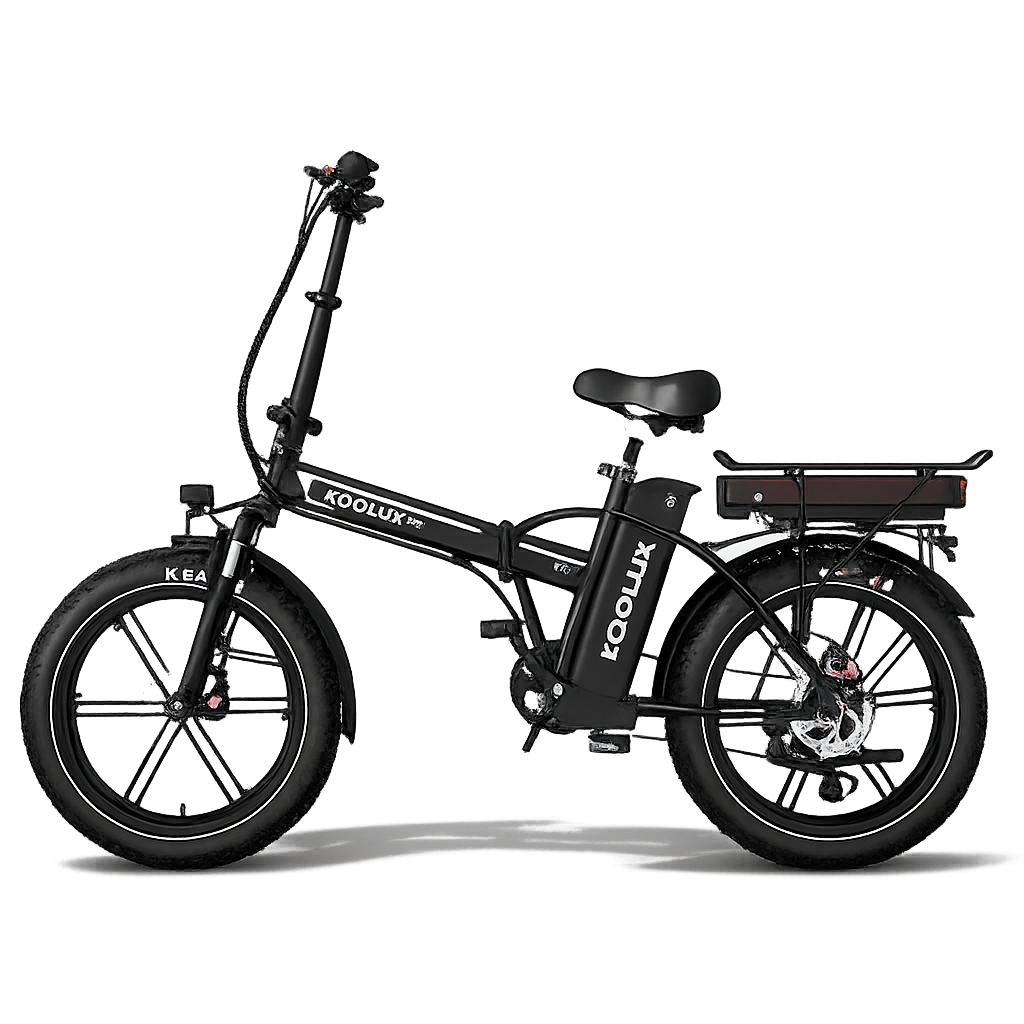
KOOLUX X11 — £899 (hills and a storage problem)
500W, 20" fat tyres, hydraulic brakes and dual batteries totalling 1,123 Wh, in a bike that folds. Pick it if your commute involves both a gradient and nowhere to keep a full-size bike — see the folding versus full-size comparison.
What we would not pick for serious hills
The KOOLUX X10 at £499 is an excellent flat-town bike — 350W, 36V and 25.6 kg, the lightest thing we sell. But 350W on 36V is the combination that sags soonest on a long 15% climb. If you live somewhere steep, spend the extra on the X9 Mini. We would rather say that now than have you find out on the way home.
Technique is worth a gear and a half
- Change down before the hill, not on it. Shifting a chain under full motor torque is how derailleurs die.
- Keep your cadence up. Spinning at 70–80 rpm keeps the motor in its efficient range; grinding at 40 rpm heats it and drains the pack faster.
- Carry your speed in. Momentum at the bottom is free. Braking late and then restarting on a 20% pitch is the hardest thing you can ask of any e-bike.
- Do not sit in top assist the whole way up. Assist level 3 with you pedalling properly often climbs faster than level 5 with you freewheeling, because the motor is not fighting alone.
- Drop tyre pressure slightly in the wet. Fat tyres especially — a failed steep wet climb is usually traction, not power.
Common questions
Can a road-legal 250W e-bike get up a 20% hill?
Yes, with you pedalling. The 250W figure is a continuous rating, not a ceiling on short bursts, and the table above shows the motor needs roughly 400 W for a minute or two on that gradient. What a legal bike cannot do is get up it while you sit still — throttle-only, the same hill will be slow and may trigger a thermal cutback.
Do I need a mid-drive motor for hills?
For British commuting, no. Mid-drives use your gears, so they hold torque better on very long sustained climbs, and they genuinely are the better tool in the Alps. On the two-to-five-minute climbs that make up almost every UK route, a 750W hub platform on 20" wheels does the job for several hundred pounds less.
Does rider weight matter more than motor power?
Roughly equally — and weight is the one you can act on. Every 10 kg of total system weight adds about 8% to the power needed on a given gradient. It is also why a bike loaded to the edge of its 120 kg rating climbs noticeably worse than the same bike carrying 90 kg.
Will hills wear my battery out faster?
Not directly — packs age by charge cycles, not by gradient. But hills use more watt-hours per kilometre, so you complete more cycles per year for the same mileage. That is the real reason to buy more battery than your commute needs in hilly areas: a bigger pack does fewer cycles for the same riding.
Is a throttle enough to get up a steep hill?
Rarely, and it is the quickest way to overheat a hub motor. Throttles are for pulling away from junctions; on anything above about 10% you should be pedalling with the motor, not instead of it.
Ride the hill, not around it
Every bike above is held in UK stock with free delivery and a 2-year warranty. See the full range, size your battery with the range guide, and if you are employed, Cycle to Work takes 28–42% off the price.